Separate Tickets vs One Booking
Planning a connecting journey? Learn the difference between separate tickets and one booking, how missed connections are handled, and what Pakistani travellers should know before booking.
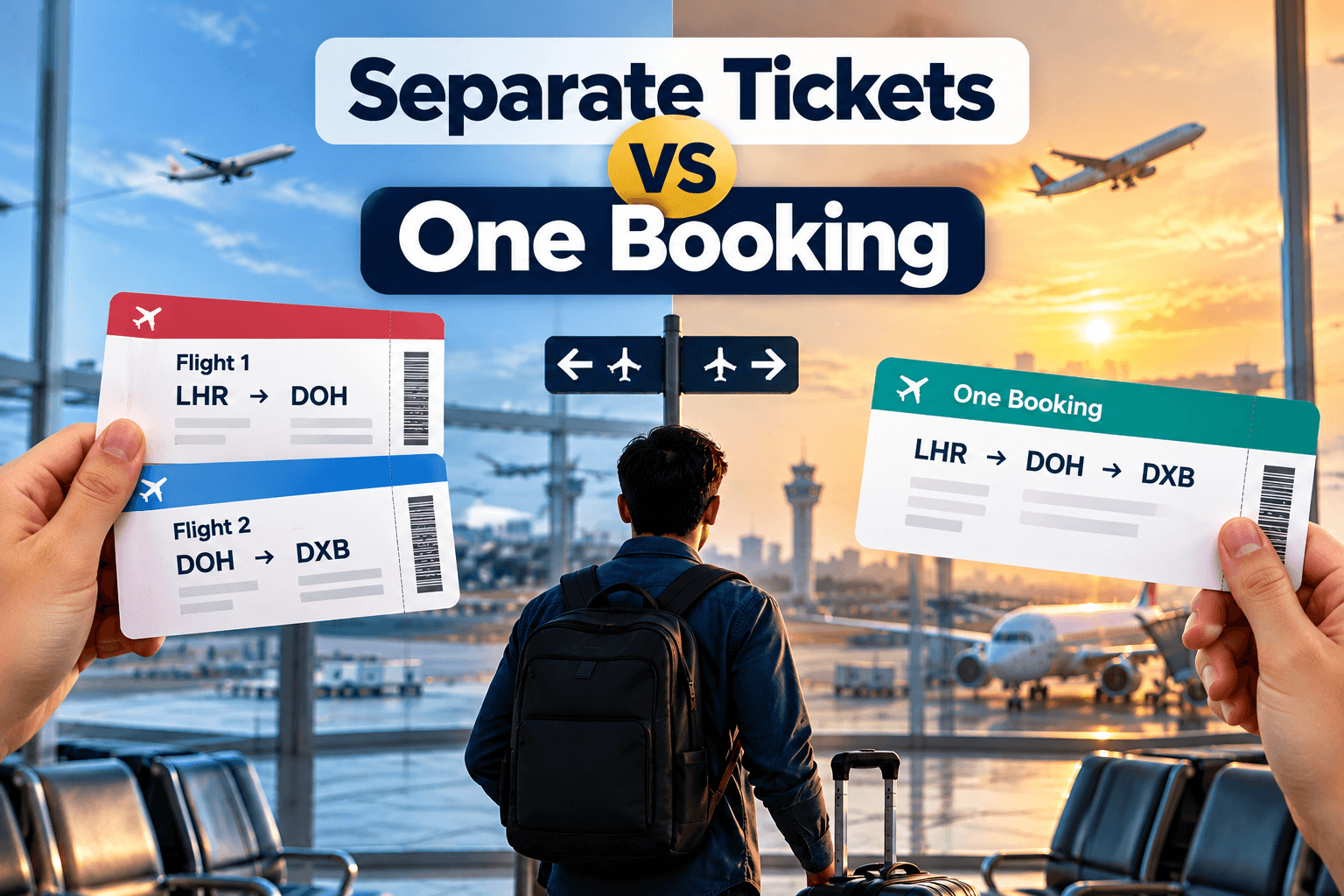
Separate Tickets vs One Booking: What's the Difference?
When booking an international trip with a connecting flight, travellers often see two options: book the entire journey together or buy each flight separately.
At first, separate tickets can look attractive because they may offer cheaper fares or more flexible schedules. However, there can be an important difference in how your journey is protected if something goes wrong.
For example:
One booking: Lahore → Doha → London
versus:
Separate tickets: Lahore → Doha Doha → London
Both itineraries may look similar on your phone, but the way airlines handle delays, missed connections, baggage and rebooking can be very different.
This guide explains the difference between separate tickets and one booking and what travellers should consider before booking a connecting journey.
What Is One Booking?
A one booking generally means that your connecting flights are arranged together as one itinerary through the airline or travel seller.
For example:
Lahore → Doha → London
You book both flights as part of the same journey.
The flights may be operated by:
- The same airline
- A codeshare partner
- An interline partner
- Different airlines participating in the same ticketed itinerary
The important point is not simply that the flights appear together on a screen. You should check how the itinerary is ticketed and whether the connection is protected.
Airline reservation systems support arrangements where different airlines can participate in the same itinerary through interline and other agreements.
What Are Separate Tickets?
Separate tickets mean that you purchase different flights as independent bookings or ticket documents.
For example:
Ticket 1: Lahore → Doha
Ticket 2: Doha → London
Even though you are travelling to London, the two flights may be treated as separate journeys.
This can become important if your first flight is delayed and you miss the second flight.
The second airline may not be responsible for protecting the connection simply because the flights were booked close together or appear in the same travel plan.
The Biggest Difference: What Happens If You Miss the Connection?
This is probably the most important difference between the two arrangements.
One protected booking
Suppose your itinerary is:
Lahore → Doha → London
Your Lahore–Doha flight is delayed and you miss the Doha–London connection.
If the connection is protected under the applicable ticketing arrangement, the airline or responsible carrier may arrange an alternative connection.
IATA's interline guidance describes procedures for passengers who arrive too late to make an interline connection, including cancellation of unusable onward space and rebooking where necessary.
Separate tickets
Now consider:
Ticket 1: Lahore → Doha Ticket 2: Doha → London
If the Lahore–Doha flight is delayed and you miss your separately ticketed Doha–London flight, the second airline may treat the situation as a missed flight on its own ticket.
You could potentially face:
- Rebooking charges
- Fare differences
- No-show consequences
- Loss of the unused flight
- New-ticket costs
The exact outcome depends on the airlines, ticket conditions and circumstances.
Simple Example
Imagine you have:
Flight A: Lahore → Dubai Departure: 10:00 AM Arrival: 12:00 PM
Flight B: Dubai → Paris Departure: 2:00 PM
You have two hours between flights.
Scenario 1: One protected booking
Both flights are issued as part of a protected itinerary.
If Flight A is delayed and you miss Flight B, the airline may have procedures to move you to another available flight, subject to the applicable rules.
Scenario 2: Separate tickets
Flight A and Flight B are purchased separately.
Flight A is delayed until 3:00 PM.
You arrive in Dubai after Flight B has departed.
The second airline may consider you a passenger who missed your separately booked flight.
You may have to arrange and pay for another flight.
This is why a cheap separate-ticket connection can sometimes carry additional financial risk.
Does One Booking Always Mean One Ticket?
Not necessarily.
This is an important distinction.
Travellers sometimes use the terms booking, PNR, ticket and itinerary as though they mean exactly the same thing. They do not always mean the same thing operationally.
An itinerary can involve multiple airlines and different reservation arrangements.
For example, an airline may have specific procedures for certain separately documented feeder services that are connected to a main itinerary.
Qatar Airways, for example, states that certain separate-document arrangements can have protected connecting-time treatment when specific conditions are met, while separately sold segments or segments on separate documents of different validating carriers may not have the same protection.
Therefore, before travelling, ask:
“Are these flights protected as one connecting itinerary, or are they separate tickets?”
That question is more useful than simply asking whether both flights appear under the same travel plan.
What Is a Protected Connection?
A protected connection is a connection where the airline or ticketing arrangement recognizes the flights as part of a connected journey and provides applicable procedures if the passenger is unable to make the onward flight because of an operational disruption.
The exact protection depends on:
- Ticketing arrangement
- Airlines involved
- Interline or codeshare relationships
- Fare conditions
- Minimum connecting time
- Airport
- Reason for the missed connection
IATA defines Minimum Connecting Time (MCT) as the standard shortest interval required to transfer a passenger and baggage between connecting flights at a particular airport.
What Is a Self-Transfer?
A self-transfer is when you arrange your own connection between separately booked flights.
For example:
Ticket 1: Islamabad → Dubai
Ticket 2: Dubai → Istanbul
You are responsible for making the connection yourself.
Depending on the airport and itinerary, you may need to:
- Leave the aircraft
- Collect your baggage
- Pass immigration if required
- Enter the appropriate airport area
- Check in for the next airline
- Drop your baggage
- Pass security
- Reach the departure gate
This can take considerably longer than a normal protected connection.
Separate Tickets and Baggage
Baggage is another major difference to consider.
With a protected connecting itinerary, checked baggage may be tagged through to your final destination when the airlines and ticketing arrangement allow it.
With separate tickets, you may need to:
- Collect your baggage
- Clear immigration or customs where required
- Leave the arrival area
- Check in again
- Drop your baggage again
The exact procedure depends on the airport, airlines, ticket arrangement and destination.
Never assume that your baggage will automatically be transferred simply because you have a connecting flight.
Ask the check-in agent:
“Is my baggage checked through to my final destination?”
Do Separate Tickets Always Require Baggage Collection?
No.
It depends on the airlines, airport and ticketing arrangements.
In some circumstances, baggage may be checked through even when travel involves separate documents, while in other cases it will not be.
Therefore, the safest approach is to confirm at the first airport.
Check your baggage tag and make sure the final airport code shown on it is correct.
One Booking and Minimum Connecting Time
When airlines sell a connection as an eligible itinerary, the connection is generally planned around applicable minimum connecting-time requirements.
IATA maintains Minimum Connecting Time data for airports and describes MCT as the minimum interval required for a passenger and baggage to transfer between connecting flights.
This does not mean every connection is risk-free.
You can still experience:
- Delays
- Security queues
- Immigration delays
- Gate changes
- Weather disruptions
- Aircraft problems
However, an airline-protected connection and a self-arranged connection are not necessarily treated the same way when something goes wrong.
Why Separate Tickets Can Be Cheaper
Separate tickets can sometimes produce a lower total price.
For example:
Ticket A: Rs. 55,000 Ticket B: Rs. 35,000
Total:
Rs. 90,000
A single-ticket itinerary might cost more.
Travellers may therefore choose separate tickets to save money.
But the lower price should be compared with the additional risks and responsibilities.
You should consider:
- Connection time
- Baggage arrangements
- Airport transfer
- Immigration requirements
- Transit visa requirements
- Rebooking costs
- Hotel costs if you miss the second flight
- Availability of alternative flights
A lower ticket price does not necessarily mean a lower total travel cost if the connection fails.
Separate Tickets Can Be Useful
Separate tickets are not automatically a bad option.
They can be useful when:
You Have a Long Connection
For example, an overnight connection gives you more time to deal with delays.
You Are Staying Overnight
If you deliberately plan to spend a night in the connecting city, the risk of a short connection is reduced.
You Want Different Airlines
Separate tickets can give you access to airlines that do not offer a combined itinerary.
You Want a Lower Fare
Sometimes buying flights independently is cheaper.
You Understand the Risk
Experienced travellers may choose separate tickets because they understand how self-transfers work.
The key is to make the decision with the risks clearly understood.
What Are the Risks of Separate Tickets?
1. Missed Connection
A delay on the first flight could cause you to miss the second.
2. Additional Rebooking Cost
The second airline may require a new booking or charge applicable fees and fare differences.
3. Baggage Problems
You may have to collect and recheck your luggage.
4. Immigration Requirements
A self-transfer may require you to enter the country rather than remain airside.
5. Transit Visa Issues
Some airports or countries may require a visa depending on your nationality, passport and whether you need to pass immigration.
6. Longer Transfer Time
A self-transfer can take considerably longer than a normal airside connection.
7. Hotel Costs
If you miss the second flight, you may need to pay for accommodation.
8. New Flight Availability
The next available flight may be expensive or completely sold out.
What Happens If the First Flight Is Cancelled?
Suppose you have:
Ticket 1: Karachi → Dubai
Ticket 2: Dubai → London
If the Karachi–Dubai flight is cancelled, you need to deal with the consequences for the Dubai–London ticket separately.
The second airline may not automatically know or accept that your first flight was cancelled.
This is one of the biggest differences between a protected connection and a self-transfer.
With an airline-protected itinerary, applicable disruption procedures may provide rerouting or other solutions depending on the circumstances and rules. IATA notes that passenger rights can include reimbursement, rerouting and alternative travel, but these rights vary by jurisdiction and situation.
What Happens If the Second Flight Is Cancelled?
The situation is different because you may still be able to complete the first part of your journey.
If the second flight is separately ticketed, contact the second airline and ask about:
- Alternative flights
- Rebooking
- Refund
- Accommodation
- Other available options
The applicable solution depends on the airline and the reason for cancellation.
Separate Tickets vs One Booking: Quick Comparison
| Feature | One Protected Booking | Separate Tickets | | ----------------- | ------------------------------------------------ | ------------------------------------------------- | | Flights | Connected itinerary | Independent bookings | | Missed connection | May be protected under applicable rules | Usually your responsibility for the second ticket | | Rebooking | Airline may arrange alternative travel | You may need to deal with each airline separately | | Baggage | May be checked through | May require collection and recheck | | Connection | Usually arranged within applicable MCT framework | You must plan sufficient time yourself | | Cost | Sometimes higher | Sometimes cheaper | | Flexibility | Depends on fare | Can be more flexible across airlines | | Risk | Generally more structured | Greater self-transfer responsibility | | Airport change | Usually shown in itinerary | You must check carefully | | Visa requirements | Usually assessed for the complete itinerary | You must consider each self-transfer requirement |
Exact treatment depends on the airlines, ticketing arrangement, route and applicable rules.
How Much Connection Time Should You Leave With Separate Tickets?
There is no single safe connection time for every airport.
A two-hour connection might be enough in one situation but completely unsuitable in another.
Consider:
- Airport size
- International or domestic transfer
- Immigration
- Security
- Baggage collection
- Recheck-in
- Terminal changes
- Airport changes
- Time of day
- Airline check-in deadline
- Visa requirements
For a self-transfer involving checked baggage and immigration, many travellers deliberately leave a much larger buffer than they would for a protected connection.
If missing the second flight would be expensive, an overnight connection can sometimes provide a larger safety margin.
What About Different Airports?
This requires extra caution.
For example:
London Heathrow → London Gatwick
or:
Dubai International → Abu Dhabi airport
If your separate tickets require changing airports, you need to arrange transportation yourself and make sure you are legally allowed to enter or transit through the relevant country.
Never assume that an airport change is simply another terminal transfer.
Can Travel Insurance Protect a Separate-Ticket Connection?
Travel insurance may provide coverage for certain missed connections or travel disruptions, depending on the policy.
However, coverage is not automatic.
Before relying on insurance, check:
- Whether separate tickets are covered
- What causes of missed connection qualify
- Minimum delay requirements
- Maximum reimbursement
- Accommodation coverage
- Transportation coverage
- Required evidence
- Exclusions
Keep all relevant documents and receipts if you need to make a claim.
What Should Pakistani Travellers Check Before Booking?
If you are travelling from Pakistan on separate tickets, check the following before paying:
Passport and Visa
Confirm that your passport and destination documents are valid.
Transit Visa
Check whether you need a transit visa for the connecting country.
Airport
Confirm whether both flights use the same airport.
Terminal
Check whether you need to change terminals.
Baggage
Find out whether baggage will be checked through.
Connection Time
Allow enough time for delays, immigration, baggage and check-in.
Airline Check-In Deadline
Your second airline may have a strict check-in closing time.
Rebooking Cost
Find out what happens if you miss the second flight.
Travel Insurance
Check whether your policy covers separate-ticket connections.
Total Cost
Compare the actual cost, not just the ticket prices.
Example: Which Situation Is Safer?
Consider two itineraries.
Option A — One Booking
Lahore → Doha → Frankfurt
Both flights are part of a protected itinerary.
The first flight is delayed and you miss the connection.
The airline's applicable disruption procedures may allow you to be rebooked to Frankfurt.
Option B — Separate Tickets
Lahore → Doha
and
Doha → Frankfurt
The first flight is delayed and you miss the second flight.
You may need to contact the second airline and pay according to its ticket rules.
The difference can become significant when flights are full and replacement fares are expensive.
Questions to Ask Your Travel Agent
If you are booking a connecting international journey through a travel agency, ask:
1. Are both flights on one ticket?
2. Are the flights protected as one connection?
3. Are the tickets issued separately?
4. If I miss the connection because of a delay, who will rebook me?
5. Will my baggage go to the final destination?
6. Do I need to collect and recheck my baggage?
7. Do I need a transit visa?
8. Are both flights from the same airport?
9. What happens if the first flight is cancelled?
10. What will I have to pay if I miss the second flight?
Getting these answers before departure can prevent serious problems later.
How to Reduce the Risk of a Separate-Ticket Connection
If you decide to use separate tickets, consider these precautions:
Choose a Longer Connection
Avoid extremely short self-transfers.
Consider an Overnight Stop
This can provide a much larger buffer.
Travel With Carry-On Only When Practical
Not having checked baggage can simplify some self-transfers, although immigration and check-in requirements may still apply.
Check Visa Requirements
Do this before buying the ticket.
Check Both Airlines' Check-In Deadlines
The second airline may close check-in earlier than you expect.
Keep Emergency Funds Available
A missed separate-ticket connection may require an unexpected replacement ticket or hotel.
Keep Both Bookings Accessible
Save both confirmation numbers, tickets and airline contact details.
One Booking Does Not Mean You Can Ignore Connection Rules
Even with one booking, you should still pay attention to your connection.
Check:
- Connection time
- Terminal
- Airport
- Passport requirements
- Transit visa
- Baggage
- Security procedures
A protected itinerary reduces certain risks, but it does not eliminate every possible travel problem.
Separate Tickets vs One Booking: Which Should You Choose?
The right choice depends on your trip, budget and willingness to manage connection risks.
A one-booking protected itinerary can simplify the handling of disruptions because the connecting journey may be covered by the applicable airline and ticketing arrangements.
Separate tickets can offer lower prices, different airline combinations or greater flexibility, but they place more responsibility on the traveller to manage the connection.
Before booking, compare:
Ticket price + connection time + baggage + visa requirements + missed-connection risk + possible rebooking cost.
Do not compare ticket prices alone.
Final Checklist Before Booking a Connecting Flight
Before purchasing your ticket, ask:
☑ Are all flights on one ticket? ☑ Is the connection protected? ☑ Are the flights operated by the same airline or partners? ☑ Is the connection within the applicable minimum connecting time? ☑ Will baggage be checked through? ☑ Do I need to pass immigration? ☑ Do I need a transit visa? ☑ Are both flights at the same airport? ☑ What happens if the first flight is delayed? ☑ What happens if I miss the second flight? ☑ How much will rebooking cost? ☑ Does my travel insurance cover the arrangement?
Frequently Asked Questions
Is it better to book connecting flights on one ticket?
A single protected itinerary can make disruption handling more straightforward because applicable airline and ticketing procedures may cover the connection. However, the exact protection depends on the ticket and airlines involved.
Are separate tickets cheaper?
They can be, but not always. Compare the total cost and the potential costs of a missed connection, baggage, airport transfers and rebooking.
What happens if I miss a connecting flight on separate tickets?
You may need to contact the airline operating the missed flight and arrange rebooking under its applicable ticket rules. Additional fees or fare differences may apply.
What happens if I miss a connection on one booking?
If the connection is protected and the missed connection results from an eligible operational disruption, the airline may have procedures for rerouting or rebooking you. The exact solution depends on the airline, ticket and applicable rules.
Will my baggage be transferred automatically between separate tickets?
Not necessarily. Ask the check-in agent and verify the baggage tag. You may need to collect and recheck your baggage.
Can I use separate airlines for a connecting journey?
Yes. Travellers can book flights with different airlines, but they should check whether the flights are connected through an interline or other ticketing arrangement or are simply separate bookings.
How much connection time should I leave between separate tickets?
There is no universal minimum that guarantees a successful self-transfer. Allow substantially more time than a normal protected connection, especially if you need baggage collection, immigration, security or an airport change.
Do separate tickets affect travel insurance?
They can. Insurance policies differ, so check whether your policy specifically covers missed connections involving separate tickets.
Can a travel agent book separate tickets?
Yes. If you are using a travel agent, ask them clearly whether the flights are being issued as one connected itinerary or as separate tickets.
Conclusion
The difference between separate tickets and one booking becomes most important when something goes wrong.
A protected connecting itinerary can provide a more structured process for handling disruptions, while separate tickets can leave the traveller responsible for arranging the next flight if the connection is missed.
Separate tickets can still be useful and may sometimes save money, but they require careful planning.
Before booking, always check the ticketing arrangement, connection time, baggage process, airport, transit visa requirements and missed-connection rules.
For international travellers from Pakistan, taking a few extra minutes to understand these details before purchasing a ticket can help avoid expensive surprises during the journey.
Share this article
Keep Exploring
Related Articles
How Airline Rebooking Works
Flight disrupted or cancelled? Learn how airline rebooking works, when you may be rebooked, what happens to connecting flights, possible fees, and what passengers should do next.
18 September 2026

No-Show on a Flight Ticket Explained
Missed your flight or failed to cancel before departure? Learn what “no-show” means, what can happen to your ticket, onward flights, refunds and rebooking options.
17 September 2026

.Flight Cancellation: What Should You Do?
Has your flight been cancelled? Learn what to do next, how to check rebooking options, protect your connecting flights, request a refund, and handle hotels, baggage and travel insurance.
17 September 2026
Need help planning your journey?
Contact New Umer Holidays Travel for flights, Umrah services, visa assistance, hotel bookings and travel insurance.