Airline Fare Classes Explained
Airline fare classes can affect your ticket price, baggage, seat selection, and flexibility. Learn how fare classes work and what to check before booking.
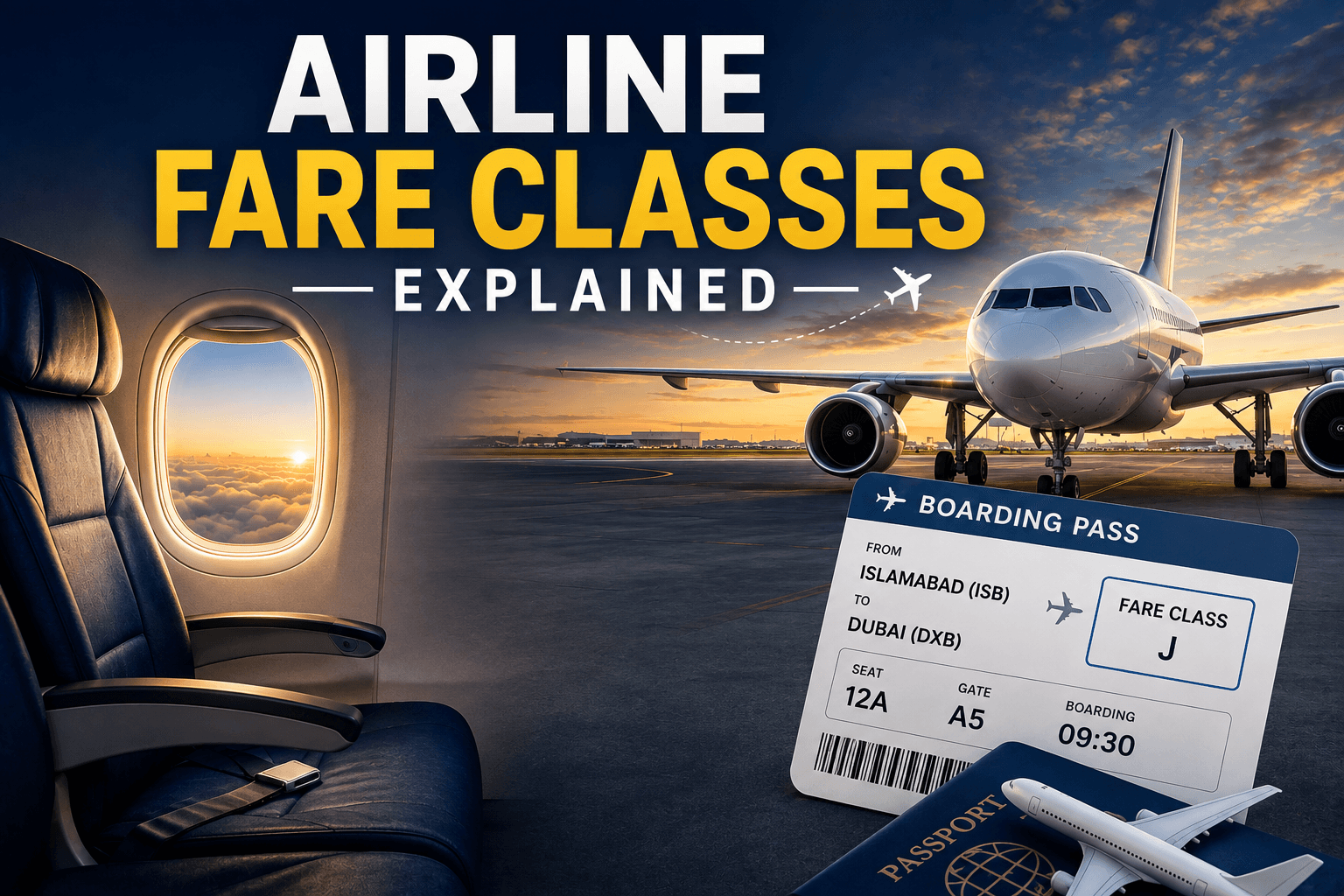
Airline Fare Classes Explained: What Do They Mean?
When searching for flights, you may notice that an airline offers several different prices for what appears to be the same Economy or Business Class seat.
Why are there different prices?
The answer is often fare classes.
Fare classes are categories used by airlines to manage ticket prices, availability, rules, and booking conditions. Understanding them can help you compare flight options and avoid choosing a cheaper fare that doesn't provide the flexibility or baggage allowance you need.
What Is an Airline Fare Class?
An airline fare class is a category that identifies the type of ticket you are purchasing.
Fare classes are usually represented by a letter, such as:
- Y
- B
- M
- K
- H
- L
- Q
- J
- C
- F
The exact meaning of each letter varies between airlines.
For example, one airline may use a particular letter for a flexible Economy fare, while another airline may use the same letter differently.
This means you should not assume that a specific letter always has the same meaning across every airline.
Fare Class vs Travel Class
Fare class and travel class are not the same thing.
Travel class describes the cabin you are travelling in:
- Economy Class
- Premium Economy
- Business Class
- First Class
Fare class identifies the specific fare category within that cabin.
For example, two passengers may both sit in Economy Class but have different fare classes.
One passenger might have a cheaper Economy fare with limited flexibility, while another may have a more expensive Economy fare with better change and refund conditions.
Why Do Airlines Have Different Fare Classes?
Airlines use different fare classes to offer different prices and conditions to passengers.
A flight may have:
- Low-priced Economy fares
- Standard Economy fares
- Flexible Economy fares
- Premium Economy fares
- Business Class fares
- Fully flexible Business Class fares
The differences may include:
- Ticket price
- Baggage allowance
- Seat selection
- Refundability
- Date-change fees
- Cancellation conditions
- Upgrade eligibility
- Frequent-flyer benefits
Common Fare Class Letters
There is no universal system that applies to every airline, but some letters are commonly associated with certain types of fares.
Y Class
Y is commonly associated with a full-fare Economy ticket on many airlines.
It may offer greater flexibility than discounted Economy fares, but the exact rules depend on the airline.
B, M, H and K Classes
These letters are often used for different Economy fare levels.
They may represent different combinations of price, flexibility, baggage, or mileage benefits.
However, their exact meaning varies by airline.
J and C Classes
These letters are commonly associated with Business Class fares on many airlines.
Again, the exact fare conditions depend on the airline.
F Class
F is commonly associated with First Class on many airline booking systems.
The benefits and conditions depend on the airline and ticket purchased.
Does a Cheaper Fare Class Mean a Worse Seat?
Not necessarily.
Two passengers travelling in Economy Class may sit next to each other while paying different prices because they purchased different fare types.
The difference may be in the ticket conditions, rather than the physical seat itself.
For example:
Passenger A may purchase a cheaper Economy fare.
Passenger B may purchase a more flexible Economy fare.
Both passengers could potentially sit in the same type of Economy seat, but Passenger B may have better conditions for changing or cancelling the ticket.
How Fare Classes Affect Ticket Prices
Airlines usually have a limited number of seats available at each fare level.
For example, an airline might make a small number of seats available at its lowest fare.
Once those seats are sold, the next fare level may become available.
This is one reason flight prices can change even when the flight itself has not changed.
As the lower-priced fare classes sell out, higher-priced fare classes may remain.
Fare Class and Baggage Allowance
Your fare class can sometimes affect your baggage allowance.
However, baggage allowance is also determined by factors such as:
- Airline
- Route
- Fare type
- Travel class
- Frequent-flyer status
For example, one Economy fare may include checked baggage while another may only include cabin baggage.
Always check the baggage allowance shown with your specific ticket before booking.
Fare Class and Seat Selection
Some fare types include free seat selection, while others may require an additional payment.
A more flexible fare may include better seat-selection options, while a basic fare could charge separately for selecting a seat.
Seat-selection rules vary between airlines.
Fare Class and Ticket Changes
One of the biggest differences between fare types can be the ability to change your flight.
A cheaper fare may have:
- Higher change fees
- Fare differences
- Limited changes
- No changes allowed
A flexible fare may offer more generous change conditions.
Before choosing the cheapest option, check the airline's change rules.
Fare Class and Refunds
Refund conditions can also vary significantly.
Some fares may be:
- Fully refundable
- Partially refundable
- Refundable with a fee
- Non-refundable
A cheap ticket can become expensive if your plans change and the ticket provides very limited flexibility.
Always read the fare conditions before purchasing.
Fare Class and Frequent-Flyer Miles
Fare class can sometimes affect the number of frequent-flyer miles or status credits you earn.
A higher fare class may earn more qualifying miles or points than a heavily discounted fare.
The exact calculation depends on the airline and frequent-flyer program.
If you regularly collect airline miles, checking the earning rules can be worthwhile.
Basic Economy vs Standard Economy
One of the most common differences travellers see today is between Basic Economy and standard Economy fares.
Basic Economy
Basic Economy may offer a lower price but can come with restrictions such as:
- Limited seat selection
- Limited flexibility
- Additional baggage charges
- Restrictions on changes or refunds
Standard Economy
A standard Economy fare may offer additional benefits, such as:
- Better baggage allowance
- More seat-selection options
- Greater flexibility
- Better change conditions
The exact benefits depend on the airline.
How to Choose the Right Fare Class
Don't choose a fare based only on the ticket price.
Before booking, compare:
- Baggage allowance.
- Seat-selection options.
- Change fees.
- Refund conditions.
- Cancellation rules.
- Meal or onboard benefits.
- Frequent-flyer earning.
- Upgrade eligibility.
- Total price after additional fees.
Sometimes paying slightly more for a better fare can provide significantly more flexibility.
Example: Two Economy Tickets
Imagine an airline offers two Economy options:
Economy Basic
Price: Lower
Baggage: Limited
Seat Selection: Additional fee
Changes: Restricted
Refund: Not available
Economy Flex
Price: Higher
Baggage: Included
Seat Selection: Included or more flexible
Changes: More flexible
Refund: Better conditions
The second ticket costs more, but it may provide better value if you need baggage or think your travel plans could change.
Does Fare Class Affect Your Seat?
The fare class does not necessarily determine whether you sit in Economy, Business, or First Class.
However, it can affect which seats you can select and whether seat selection costs extra.
Your actual seat also depends on:
- Aircraft layout
- Availability
- Seat-selection rules
- Airline policy
- Ticket type
Tips Before Booking a Flight
Before paying for a ticket:
- Check the fare conditions.
- Confirm your baggage allowance.
- Check whether seat selection costs extra.
- Review change and cancellation rules.
- Compare the total price, not just the base fare.
- Check whether the fare earns frequent-flyer points.
- Make sure the ticket matches your travel needs.
Final Thoughts
Airline fare classes can seem confusing, but understanding the basics can help you make better flight-booking decisions.
The cheapest fare is not always the best value. A slightly more expensive fare may include baggage, better seat-selection options, easier changes, or improved refund conditions.
When comparing flights, look beyond the headline price and check exactly what is included in the fare you are purchasing.
For international travellers from Pakistan, especially those booking long-haul flights, understanding fare conditions can help avoid unexpected costs and make the overall journey much smoother.
If you need help comparing international flight options, baggage allowances, or ticket conditions, New Umer Holidays can assist you in choosing a flight that fits your travel needs.
Share this article
Keep Exploring
Related Articles

Multi-City Flights
Planning to visit multiple cities? Learn how multi-city flights work, their benefits, booking process, and important tips for travellers.
24 September 2026
Separate Tickets vs One Booking
Planning a connecting journey? Learn the difference between separate tickets and one booking, how missed connections are handled, and what Pakistani travellers should know before booking.
18 September 2026
How Airline Rebooking Works
Flight disrupted or cancelled? Learn how airline rebooking works, when you may be rebooked, what happens to connecting flights, possible fees, and what passengers should do next.
18 September 2026
Need help planning your journey?
Contact New Umer Holidays Travel for flights, Umrah services, visa assistance, hotel bookings and travel insurance.