Power Banks on Flights
Can you take a power bank on a flight? Learn where to pack it, common airline restrictions, battery capacity rules, and important safety tips for travellers.
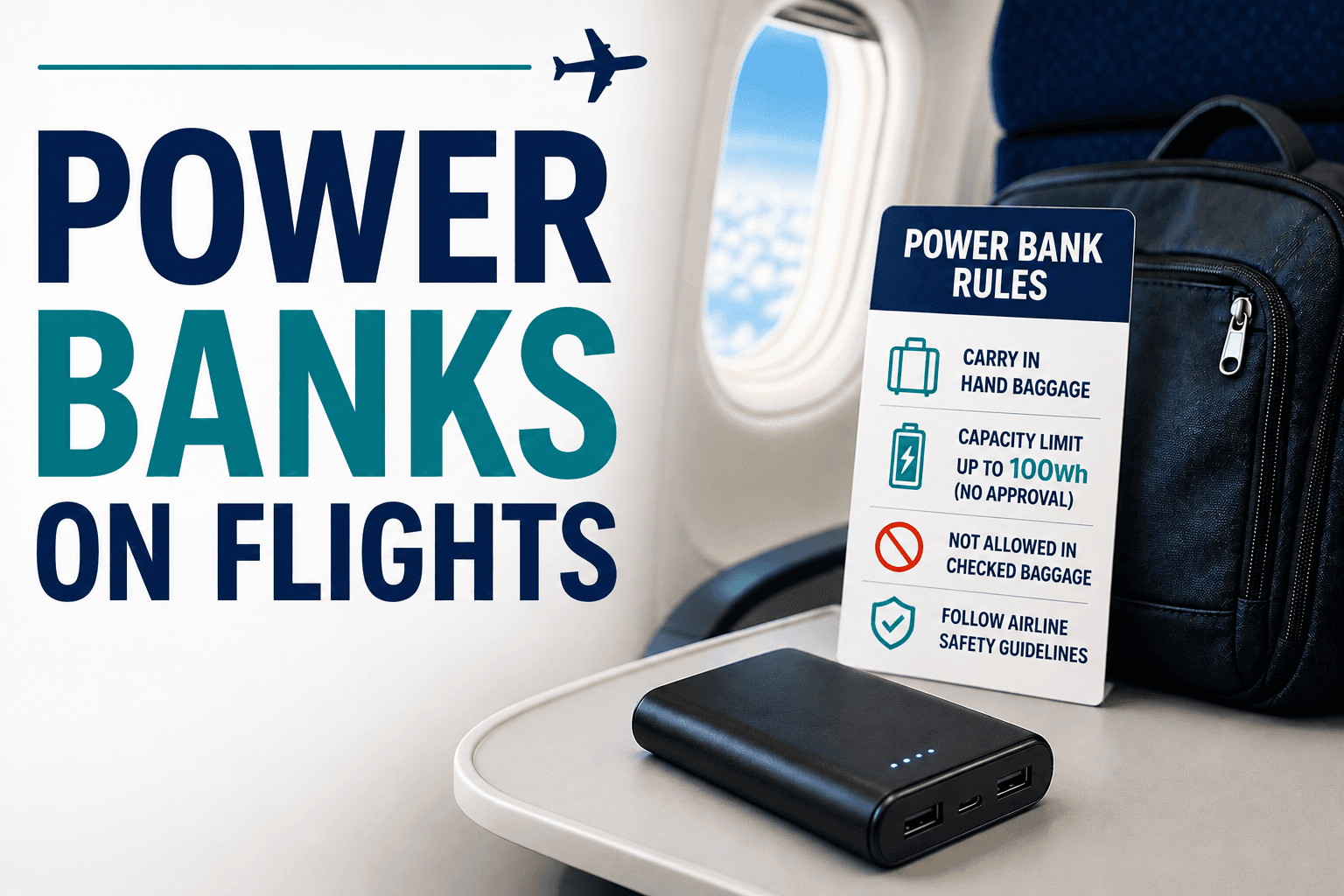
Power Banks on Flights: Rules, Restrictions & Travel Tips
Power banks are extremely useful when travelling. They can keep your phone, tablet, headphones, and other electronic devices charged when you are away from a power outlet.
However, because power banks contain lithium-ion batteries, airlines and aviation authorities have specific rules about how they can be carried on flights.
Understanding these rules before reaching the airport can help you avoid delays or having your power bank removed from your baggage.
What Is a Power Bank?
A power bank is a portable rechargeable battery used to charge electronic devices such as:
- Smartphones
- Tablets
- Wireless headphones
- Smartwatches
- Cameras
- Other USB-powered devices
Most modern power banks use lithium-ion or lithium-polymer batteries.
Can You Take a Power Bank on a Flight?
Generally, power banks should be carried in cabin or carry-on baggage, rather than checked baggage.
This is because lithium batteries can pose a fire risk if they are damaged or malfunction.
However, exact requirements can vary by airline and aviation authority.
Always check the latest rules of your airline before travelling.
Why Can't Power Banks Usually Go in Checked Baggage?
Power banks contain lithium batteries, which can potentially overheat or catch fire.
If a battery-related incident occurs inside the passenger cabin, crew members can respond more quickly.
For this reason, spare lithium batteries and power banks are generally required to remain accessible in the cabin rather than being placed inside checked luggage.
Where Should You Pack Your Power Bank?
The safest approach is to keep your power bank in your carry-on baggage or another location permitted by your airline.
Protect it from:
- Physical damage
- Short circuits
- Extreme heat
- Contact with metal objects
Do not place a loose power bank where its terminals could come into contact with keys, coins, or other metal objects.
What Is mAh?
Power banks are commonly labelled with a capacity in milliamp-hours (mAh).
For example:
- 5,000 mAh
- 10,000 mAh
- 20,000 mAh
- 30,000 mAh
A higher mAh rating generally means the power bank can store more energy.
However, airlines may use watt-hours (Wh) rather than mAh when determining whether a battery is permitted.
What Is Watt-Hour (Wh)?
Watt-hours indicate the amount of energy stored in a battery.
If the Wh rating is not printed on your power bank, it can generally be estimated using:
Wh = (mAh × Voltage) ÷ 1,000
For example, a 10,000 mAh power bank rated at 3.7 volts is approximately:
37 Wh
Always use the actual specifications printed on your power bank when available.
Common Battery Capacity Categories
Airline rules can differ, but many aviation regulations use categories based on watt-hour capacity.
A commonly referenced framework is:
Up to 100 Wh
Power banks within this range are generally permitted in carry-on baggage, subject to the airline's rules.
100–160 Wh
These batteries may require airline approval and can be subject to additional restrictions.
Above 160 Wh
Larger batteries may not be permitted for passenger transport.
Because policies can vary, always confirm the current requirements with your airline before travelling.
Can You Use a Power Bank During a Flight?
This depends on the airline and current onboard safety rules.
Some airlines may restrict or prohibit the use of power banks during the flight, even when the power bank itself is permitted in cabin baggage.
Before using one onboard, follow the crew's instructions and your airline's policy.
Can You Charge Your Power Bank on the Plane?
Do not assume that you can recharge your power bank during the flight.
Airlines may have restrictions on connecting power banks to aircraft power outlets or using them to charge devices.
Follow the airline's instructions and cabin crew announcements.
Can You Carry Multiple Power Banks?
The number of power banks you can carry may be restricted by the airline or applicable aviation regulations.
If you are travelling with multiple power banks, check the airline's current policy before packing them.
Do not assume that a large number of batteries will automatically be accepted.
What If Your Power Bank Has No Capacity Label?
A power bank without a clearly identifiable capacity may create problems during security or boarding.
If the battery specifications cannot be verified, airline or security personnel may refuse to allow it onboard.
Whenever possible, travel with a power bank that clearly displays its battery capacity and relevant safety information.
Damaged Power Banks
Never travel with a power bank that is:
- Swollen
- Cracked
- Leaking
- Overheating
- Physically damaged
- Showing signs of battery failure
A damaged lithium battery can present a significant safety risk.
Replace damaged batteries instead of attempting to carry them on a flight.
Protect Your Power Bank
Keep your power bank protected while travelling.
You can:
- Store it in a protective case.
- Keep it away from liquids.
- Prevent the terminals from contacting metal objects.
- Avoid placing heavy items on it.
- Protect it from extreme temperatures.
Power Banks and International Travel
If you are travelling internationally from Pakistan, remember that you may be subject to the rules of:
- Your departure airport
- Your airline
- Transit airports
- Your destination
- Applicable aviation authorities
A power bank accepted by one airline may be subject to different conditions on another airline.
Always check the rules for your specific journey.
Power Bank Checklist Before Your Flight
Before leaving for the airport, check:
- ✅ Power bank is in your carry-on baggage.
- ✅ Capacity is clearly labelled.
- ✅ Battery is not damaged or swollen.
- ✅ Capacity complies with your airline's rules.
- ✅ Terminals are protected from short circuits.
- ✅ You have checked your airline's latest battery policy.
- ✅ You understand any restrictions on using it onboard.
Common Mistakes to Avoid
Travellers should avoid:
- Putting a power bank in checked baggage.
- Carrying damaged or swollen batteries.
- Ignoring airline-specific restrictions.
- Travelling with an unusually large battery without checking approval requirements.
- Carrying batteries with unclear specifications.
- Using a power bank onboard when the airline prohibits it.
- Packing loose batteries where they can short-circuit.
Final Thoughts
Power banks are a convenient travel essential, but they must be carried and used according to airline and aviation safety requirements.
For most travellers, the safest approach is to keep power banks in carry-on baggage, protect them from damage, and make sure their capacity is clearly identified.
Rules can change and may differ between airlines, so always check your airline's latest lithium-battery and power-bank requirements before travelling.
Pack your power bank correctly, check the rules before your flight, and travel prepared.
Share this article
Keep Exploring
Related Articles

Multi-City Flights
Planning to visit multiple cities? Learn how multi-city flights work, their benefits, booking process, and important tips for travellers.
24 September 2026

Separate Tickets vs One Booking
Planning a connecting journey? Learn the difference between separate tickets and one booking, how missed connections are handled, and what Pakistani travellers should know before booking.
18 September 2026
How Airline Rebooking Works
Flight disrupted or cancelled? Learn how airline rebooking works, when you may be rebooked, what happens to connecting flights, possible fees, and what passengers should do next.
18 September 2026
Need help planning your journey?
Contact New Umer Holidays Travel for flights, Umrah services, visa assistance, hotel bookings and travel insurance.