Prohibited Items on International Flights
Planning an international flight? Learn which items you cannot carry in your cabin or checked baggage and how to pack safely before going to the airport.
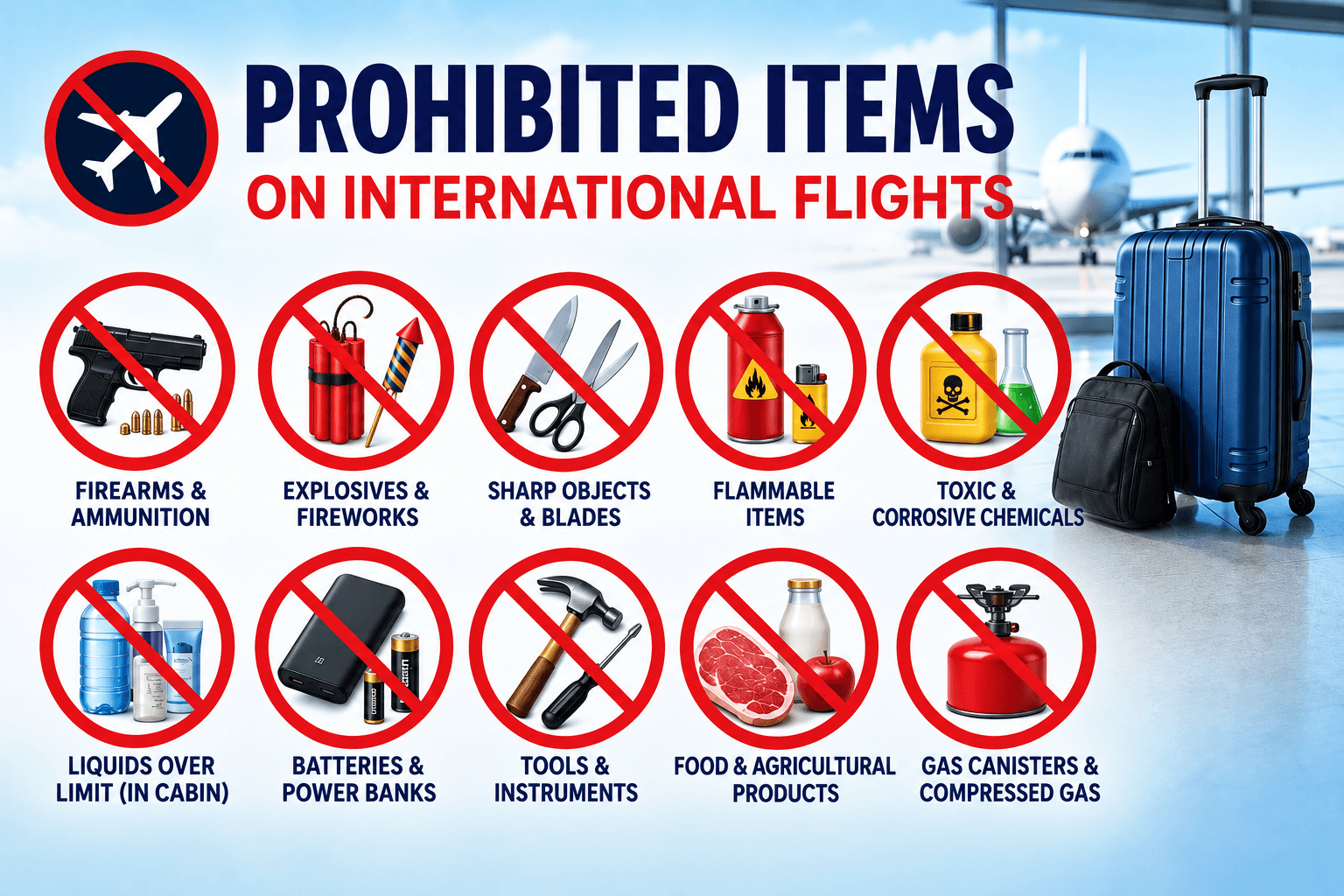
Prohibited Items on International Flights: What You Cannot Carry
Packing for an international flight is not just about choosing what you need for your trip. It is also important to know what you are not allowed to carry on the aircraft.
Airlines and airports have strict rules for items that could pose a safety or security risk. Some items may be completely prohibited, while others may be allowed only in checked baggage or only under specific conditions.
Understanding these rules before leaving for the airport can help you avoid delays, confiscation of items, or problems during security screening.
Why Are Some Items Prohibited on Flights?
Certain items can create serious risks during air travel, including fire, explosions, injury, or security threats.
Airport security and airlines therefore restrict items such as:
- Explosives
- Flammable substances
- Certain chemicals
- Weapons
- Dangerous tools
- Some batteries
- Other hazardous materials
The rules can differ depending on the item, airline, airport, and destination country.
Prohibited Items in Cabin Baggage
Cabin baggage is subject to strict security screening.
Commonly restricted or prohibited items may include:
- Weapons and firearms
- Ammunition
- Explosives
- Certain sharp objects
- Large cutting tools
- Flammable substances
- Certain chemicals
- Other dangerous goods
If an item could potentially be used to cause harm or create a safety risk, it may not be permitted in your cabin baggage.
Prohibited Items in Checked Baggage
Putting an item in checked baggage does not automatically make it acceptable.
Some dangerous items are prohibited in both cabin and checked baggage.
Examples can include:
- Explosives
- Fireworks
- Certain flammable materials
- Certain toxic or corrosive substances
- Other hazardous materials
Always check the airline and destination-country requirements before packing unusual items.
Liquids on International Flights
Liquids are subject to specific security restrictions in cabin baggage.
Common examples include:
- Water and other drinks
- Perfume
- Shampoo
- Creams
- Gels
- Lotions
- Toothpaste
Many airports apply restrictions to the quantity of liquids that can be carried through security in cabin baggage.
However, exceptions may apply to items such as medicines, baby food, and certain essential products.
Because liquid rules can vary between airports, check the requirements for your departure and transit airports before travelling.
Batteries and Electronic Devices
Lithium batteries are commonly used in:
- Smartphones
- Laptops
- Tablets
- Cameras
- Power banks
- Portable electronic devices
Some battery-powered items have specific carriage requirements.
Spare lithium batteries and power banks are generally subject to special rules and may need to be carried in cabin baggage rather than checked baggage.
Always check your airline's current battery requirements before packing them.
Medicines and Medical Equipment
Passengers may generally travel with necessary medicines, but some medications or medical equipment may have additional requirements depending on the destination.
When travelling internationally, consider carrying:
- Medicines in their original packaging
- A prescription or doctor's documentation when appropriate
- Necessary medical documents
- Medical equipment according to airline requirements
If you are carrying medication that is controlled or restricted in your destination country, check the country's requirements before travelling.
Food and Agricultural Products
Food is not necessarily prohibited on an aircraft, but bringing food into another country can be restricted.
Some destinations have strict rules concerning:
- Meat
- Dairy products
- Fresh fruit
- Vegetables
- Seeds
- Plants
- Animal products
An item that is permitted on the aircraft may still be prohibited when entering your destination country.
This is an important difference between airline security rules and customs or immigration rules.
Sharp Objects
Sharp objects may be restricted in cabin baggage because they can present a security risk.
Examples can include:
- Large knives
- Certain scissors
- Blades
- Cutting tools
- Other sharp instruments
Rules vary according to the type and size of the item.
If you need to travel with an allowed sharp tool, check whether it must be packed in checked baggage.
Sporting Equipment
Some sporting equipment cannot be carried in the cabin because of its size, shape, or potential to cause injury.
Examples can include:
- Bats
- Certain sports sticks
- Golf clubs
- Some types of equipment with sharp edges
Airlines may allow certain sporting equipment as checked baggage, sometimes with additional fees or packaging requirements.
Flammable and Hazardous Items
Many flammable and hazardous substances are restricted or prohibited on passenger aircraft.
These can include certain:
- Fuels
- Paints
- Solvents
- Gas containers
- Chemicals
- Aerosols
- Fireworks
Do not pack an unfamiliar chemical or hazardous product without checking the applicable rules first.
What About Everyday Items?
Some everyday products can have special restrictions.
For example, travellers may be surprised to learn that items such as:
- Aerosol products
- Large batteries
- Camping equipment
- Gas cartridges
- Certain tools
- Self-heating products
may require special handling or may not be permitted.
If you are unsure about an item, check with your airline before packing it.
Cabin Baggage vs Checked Baggage
An item can have different rules depending on where you carry it.
| Item Type | Cabin Baggage | Checked Baggage | |---|---|---| | Liquids | Restrictions apply | Larger quantities may be permitted depending on the item | | Power Banks | Usually cabin only | Generally not permitted in checked baggage | | Sharp Objects | Often restricted | Some may be allowed | | Fireworks | Not permitted | Not permitted | | Dangerous Chemicals | Restricted | Restricted | | Laptop | Generally permitted | May be subject to airline rules |
These are general guidelines. Always check the specific airline and airport requirements for your journey.
What Happens If Security Finds a Prohibited Item?
If airport security identifies a prohibited item, you may be required to remove it from your baggage.
Depending on the item and local regulations, it may be:
- Confiscated
- Handed back if you can take it outside the secure area
- Required to be placed in checked baggage when permitted
- Reported to the appropriate authorities in serious cases
Do not assume that an item will be accepted simply because you have travelled with it before.
Tips for Packing for an International Flight
Before leaving for the airport:
- Check your airline's baggage rules.
- Check the departure airport's security requirements.
- Check the rules at transit airports.
- Check your destination country's customs restrictions.
- Keep medicines properly labelled.
- Pack batteries and electronic devices according to airline rules.
- Avoid carrying unfamiliar chemicals or hazardous products.
- Keep important travel documents accessible.
- Check unusual items before packing them.
- Leave extra time for security screening.
Check Transit and Destination Rules
International travel can involve several sets of rules.
For example, you may need to follow:
- Departure airport security rules
- Airline baggage rules
- Transit-country requirements
- Destination-country customs rules
An item that is acceptable at your departure airport may still create problems when entering another country.
This is particularly important when travelling with food, medicines, plants, animal products, and other regulated items.
What Should You Do If You Are Unsure?
If you are unsure whether an item is permitted, do not simply pack it and hope that security allows it through.
Check:
- Your airline's official baggage information
- Your departure airport's security guidance
- The relevant authorities in your destination country
For unusual or potentially dangerous items, contact the airline before travelling.
Final Thoughts
Knowing what you can and cannot carry is an important part of preparing for an international flight.
Many everyday items are perfectly acceptable, but certain liquids, batteries, sharp objects, chemicals, food products, and dangerous goods may be restricted or prohibited.
Rules can vary between airlines, airports, and countries, so always check the current requirements for your specific journey before packing.
A few minutes of preparation can help you avoid unnecessary delays, confiscated items, and problems at airport security.
If you are planning an international trip from Pakistan, New Umer Holidays can help you with flight bookings and travel planning.
Share this article
Keep Exploring
Related Articles

Multi-City Flights
Planning to visit multiple cities? Learn how multi-city flights work, their benefits, booking process, and important tips for travellers.
24 September 2026

Separate Tickets vs One Booking
Planning a connecting journey? Learn the difference between separate tickets and one booking, how missed connections are handled, and what Pakistani travellers should know before booking.
18 September 2026
How Airline Rebooking Works
Flight disrupted or cancelled? Learn how airline rebooking works, when you may be rebooked, what happens to connecting flights, possible fees, and what passengers should do next.
18 September 2026
Need help planning your journey?
Contact New Umer Holidays Travel for flights, Umrah services, visa assistance, hotel bookings and travel insurance.